

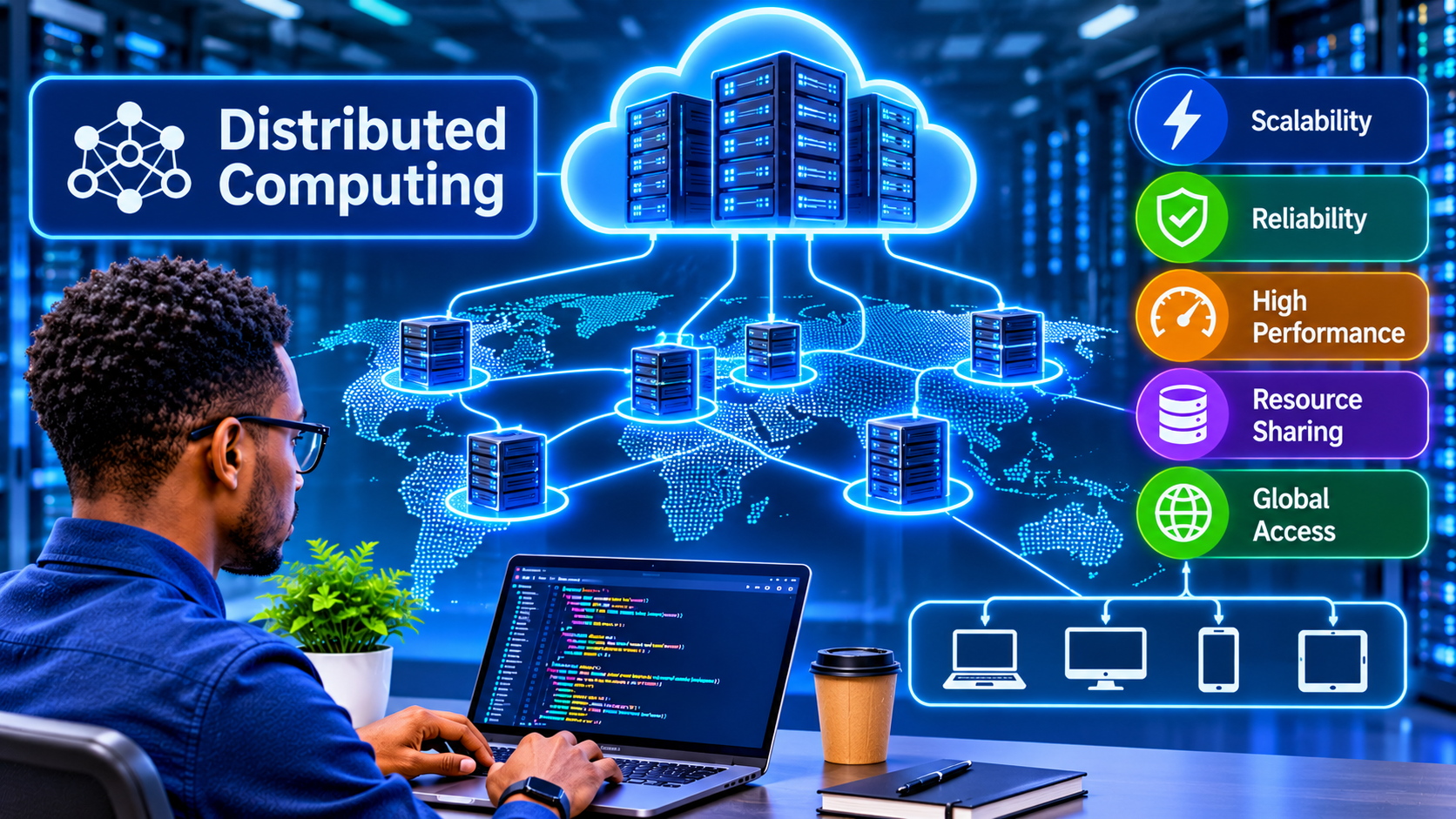
Distributed Computing: How Modern Systems Process Data
Introduction
The rapid growth of digital technology has created an enormous demand for systems capable of processing large volumes of data quickly, efficiently, and reliably. From online banking and e-commerce platforms to artificial intelligence, cloud computing and social media, modern applications must handle millions of operations while serving users across different geographical locations. Traditional computing systems often depend on a single computer or centralized server to process information. Although this approach works for smaller applications, it can become inefficient when workloads increase or applications require greater processing power.
Distributed computing provides a solution by allowing multiple interconnected computers to work together to complete tasks, process information, and share resources. Instead of relying on one machine, computing activities are divided among several systems that communicate through networks. Today, distributed computing is a fundamental technology behind modern digital services, enabling faster data processing, improved scalability and greater system reliability.
Understanding Distributed Computing
Distributed computing is a computing model in which multiple independent computers, known as nodes, communicate and collaborate to perform tasks or solve problems. These computers are connected through a network and share processing responsibilities. Each node can perform specific operations while communicating with other nodes to exchange information and coordinate activities. Unlike traditional centralised computing, where a single computer performs most processing tasks, distributed computing divides workloads across multiple machines.
For example, consider an online shopping platform that receives thousands of customer requests simultaneously. Instead of processing every request on one server, the system can distribute activities across different servers responsible for customer authentication, product searches, payment processing, inventory management and order tracking. This arrangement allows different components to operate simultaneously, improving the platform’s ability to handle large workloads. The main objective of distributed computing is to improve processing capacity, resource utilisation, system availability and performance by combining the capabilities of multiple computers.
How Distributed Computing Works
Distributed computing operates by dividing large tasks into smaller operations that can be executed across multiple connected computers. Although implementations vary, the process generally follows several stages.
Step 1
Task Distribution: A large computing task is divided into smaller subtasks. These subtasks are assigned to different computers or processing nodes within the distributed system.
Step 2
Parallel Processing: Multiple nodes process their assigned tasks simultaneously and this reduces the time required to complete workloads that can be handled independently.
Step 3
Communication Between Nodes: The participating computers exchange information through network connections. They communicate using protocols, APIs, messaging systems, or other communication mechanisms.
Step 4
Coordination and Synchronisation: The distributed system coordinates activities to ensure that nodes work correctly together. It manages task allocation, data consistency, resource availability and communication between components.
Step 5
Result Collection: After processing their assigned tasks, individual nodes return their results. These results are combined or coordinated to produce the final output.
For example, a data analytics platform may divide a large dataset into smaller sections, distribute them across several processing machines, analyse the sections simultaneously and combine the results into a comprehensive report. This approach makes it possible to process large volumes of information more efficiently than relying on a single machine.
Key Components of Distributed Computing
A distributed computing system consists of several components that work together to support communication, processing and data management.
- Nodes: These are individual computers, servers, or virtual machines that participate in the distributed system. Each node performs specific computing tasks and communicates with other nodes.
- Network Infrastructure: Networks connect the participating computers and allow them to exchange information. Reliable network communication is essential for coordinating distributed operations.
- Distributed Database: A distributed database stores information across multiple computers or geographical locations. It helps applications access and manage data across different parts of the system.
- Middleware: Middleware provides communication and coordination services between distributed applications. It helps different software components interact even when they operate on separate machines.
- Load Balancers: Load balancers distribute incoming requests across multiple servers to prevent individual machines from becoming overloaded.
- Coordination Mechanisms: These mechanisms help nodes agree on important system operations, manage distributed tasks, and maintain consistency.
Together, these components provide the foundation for building efficient and dependable distributed systems.
Read: Containerization and Its Role in Modern Software Development
Types of Distributed Computing Systems
Distributed computing can be implemented through different architectures depending on the requirements of an application.
- Client-Server Architecture: In this model, clients send requests to centralised servers that provide information or services. For example, when someone visits a website, their browser sends a request to a web server, which processes the request and returns the required content. Although servers provide central service points, multiple servers can work together to distribute workloads.
- Peer-to-Peer (P2P) Computing:Peer-to-peer computing allows connected computers to share resources directly without depending entirely on a central server. Each participating computer, known as a peer, can provide and receive resources. This model is used in file-sharing networks, decentralised applications and certain communication systems.
- Cluster Computing: Cluster computing connects multiple computers to function as a coordinated computing environment. The computers work together to provide greater processing capacity, availability, or performance. Clusters are commonly used in scientific research, enterprise applications and high-performance computing.
- Grid Computing: Grid computing combines resources from multiple geographically distributed computers to solve large computational problems. Different organisations or locations can contribute computing resources to a shared workload. It is particularly useful in scientific simulations, research projects and complex mathematical calculations.
- Cloud Computing: Cloud computing provides computing resources, including servers, databases, storage and processing capabilities, through network-based services. Cloud providers use distributed infrastructure to deliver scalable services to customers. Platforms such as Amazon Web Services, Microsoft Azure and Google Cloud provide technologies that support distributed applications.
How Modern Systems Process Data Through Distributed Computing
Distributed computing plays a major role in handling the enormous volumes of information generated by modern applications and one important application is distributed data processing. Technologies such as Apache Hadoop and Apache Spark allow organisations to process large datasets across multiple computers. For example, a financial institution may receive millions of transactions from customers throughout the day. Processing this information on a single computer could create performance limitations.
With distributed computing, transaction records can be divided into smaller groups and processed across several machines. The results can then be combined to identify spending patterns, generate reports, detect suspicious activities and support business decisions and modern distributed systems also use several processing approaches.
- Batch Processing: Large collections of data are gathered and processed together at scheduled intervals. This approach is useful for generating financial reports, analysing historical transactions and processing large datasets.
- Stream Processing: Data is processed continuously as it arrives. This is useful for real-time applications such as fraud detection, online monitoring, stock market analysis, and IoT systems.
- Parallel Processing: Multiple processors or computers execute independent parts of a task simultaneously, helping reduce processing time.
- Distributed Storage: Information is stored across multiple machines to improve storage capacity, accessibility, and availability.
These approaches allow modern organisations to handle complex workloads while maintaining efficient data processing operations.
Benefits of Distributed Computing
The increasing adoption of distributed computing is driven by several important advantages.
- Improved Performance and Processing Speed: By distributing tasks across multiple computers, systems can perform several operations simultaneously. This improves processing efficiency, especially when handling large workloads that can be divided into independent tasks.
- Scalability: Distributed systems can expand by adding more computing resources when demand increases. This makes it easier for businesses to accommodate growing users, applications and data volumes.
- Greater Reliability: When a system uses multiple nodes, the failure of one computer does not necessarily mean that the entire application must stop operating. Properly designed systems can redirect workloads to healthy nodes.
- Resource Sharing: Distributed computing allows organisations to share processing power, storage and other resources across connected machines.
- Geographical Flexibility: Distributed systems can operate across different locations, allowing organisations to serve users in multiple regions and deploy computing resources closer to their customers.
- Cost Efficiency: Organisations can distribute workloads across suitable computing resources instead of continually investing in a single extremely powerful machine. However, networking, infrastructure and operational costs must also be considered.
- Better Availability: Through replication, redundancy and automated recovery mechanisms, distributed systems can maintain access to services even when individual components experience problems.
Challenges of Distributed Computing
Despite its advantages, distributed computing introduces technical challenges that require careful planning and management.
- Network Communication Problems: Distributed systems depend on network connections. Slow connections, interruptions, and communication failures can delay operations or prevent nodes from exchanging information.
- Data Consistency: When information is stored across multiple locations, keeping all copies accurate and synchronised can be difficult. Developers must choose appropriate consistency mechanisms based on application requirements.
- Security Risks: Every additional computer, connection and communication channel can introduce potential security weaknesses. Organisations must implement authentication, encryption, access controls and continuous security monitoring.
- System Complexity: Managing multiple computers and services requires effective coordination, monitoring, and troubleshooting. A problem in one component may affect other parts of the application.
- Fault Detection and Recovery: Identifying failed nodes and restoring normal operations can be challenging. Distributed systems need appropriate monitoring, health checks, replication and recovery procedures.
- Data Synchronisation and Latency: Information travelling between geographically separated computers may experience delays. Developers must design communication and storage strategies that account for network latency.
Real-World Applications of Distributed Computing
Distributed computing supports several industries and digital services.
- Banking and Financial Technology: Financial institutions use distributed systems to process transactions, manage customer information, support fraud detection and maintain digital banking services.
- E-commerce: Online marketplaces distribute workloads across multiple services to manage product catalogues, customer accounts, payments and order processing.
- Social media: Social platforms use distributed infrastructure to store content, process user interactions, and deliver information to millions of users.
- Healthcare: Healthcare organisations can use distributed computing to support medical data management, research, imaging analysis, and collaboration between healthcare facilities.
- Cloud Services: Cloud platforms distribute computing and storage resources across infrastructure to support business applications and large-scale workloads.
- Internet of Things (IoT): Connected devices generate data that can be processed across distributed cloud and edge computing environments.
These applications demonstrate how distributed computing has become an important foundation of modern digital services.
The Future of Distributed Computing
The future of distributed computing will be influenced by developments in artificial intelligence, edge computing, cloud-native technologies and advanced networking. Artificial intelligence is increasingly being used to optimise workload distribution, monitor infrastructure, identify unusual system behaviour and improve resource allocation.
Edge computing will also become more important as connected devices generate increasing amounts of data and by processing information closer to where it is created, edge computing can reduce communication delays and improve responsiveness. Another important development is serverless computing, which allows developers to execute application functions without managing the underlying server infrastructure directly.
Furthermore, advancements in distributed databases, container orchestration and cloud-native architecture will continue to improve the flexibility and scalability of modern applications. As these technologies develop, organisations will increasingly rely on distributed systems to deliver intelligent, reliable and high-performance digital services.
Read: Demystifying Distributed Computing: How It Powers Global Tech Giants
Conclusion
Distributed computing has transformed how modern systems process and manage information and by allowing multiple interconnected computers to share workloads, it improves processing efficiency, supports scalability and enhances the reliability of digital applications. From cloud computing and online banking to artificial intelligence and big data analytics, distributed systems provide the infrastructure needed to support today’s technology-driven world.
Although challenges such as network latency, data consistency, security and system complexity remain important considerations, effective architecture and management can help organizations overcome these limitations. Ultimately, distributed computing is a major foundation of modern digital infrastructure, enabling businesses to develop faster, more flexible and more resilient technology solutions.


